

Insights
Steel Purlins. The Backbone of Modern Construction

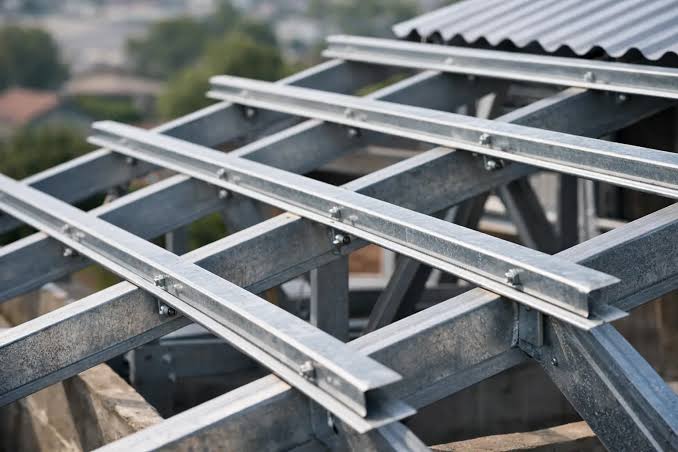
In structural engineering and steel construction, load management is everything. While primary frames—such as rafters, trusses, and columns—carry the overall weight of a structure, it is the secondary structural members that ensure those loads are distributed safely and efficiently. Among these elements, purlins play a central role in giving metal roofs their rigidity, strength, and durability.
Whether you are planning a commercial warehouse, an industrial plant, an agricultural facility, or a residential build, selecting and installing the right purlins is critical to structural integrity.
What is a Purlin?
A purlin is a horizontal structural beam installed parallel to the building’s ridge line across the primary roof trusses or rafters. Its primary function is to support the roof cladding (such as corrugated iron sheets, standing seam panels, or insulated sandwich panels) and transfer dead loads (roof weight) and environmental live loads (wind, rain, maintenance access) into the primary frame.
Key Functions of Purlins:
- Load Transfer: Collects loads from roof panels and transfers them directly to the main structural frames.
- Mid-Span Support: Reduces the unsupported length of roof rafters, preventing lateral torsional buckling.
- Cladding Fixation: Provides a rigid platform for fastening roof sheeting, cladding, and ceiling systems.
Standard Types of Steel Purlins
Cold-formed galvanized steel has largely replaced traditional timber purlins in modern industrial construction due to its superior strength-to-weight ratio, uniform quality, and resistance to pest damage and rot.
| Purlin Type | Profile & Characteristics | Ideal Application |
| Z-Purlins (ZED) | Shaped like a ‘Z’. Their asymmetric profile allows them to lap neatly over structural joints, creating continuous span configurations. | Long-span roofs, large industrial sheds, and multi-bay warehouses. |
| C-Purlins (CEE) | Shaped like a ‘C’. They feature flat vertical webs and horizontal flanges, making them stable, freestanding, and easy to bolt directly to frame cleats. | Single-span bays, building openings, floor joists, and wall girts. |
| Box/RHS/SHS Purlins | Hollow structural steel sections (Rectangular/Square). Offer high torsional resistance and a clean structural finish. | Architectural exposed roofs, heavy-load structures, and residential steel framing. |
Z-Purlins vs. C-Purlins: Choosing the Right Profile
Understanding when to specify C-purlins versus Z-purlins depends on your building’s structural layout:
- Lapping Capability: Z-purlins can be nested and lapped over support frames. Lapping doubles the thickness of the steel over the supports—where bending moment is highest—allowing for lighter gauge profiles over longer continuous spans.
- Freestanding Stability: C-purlins are self-supporting and do not require lapping. They sit flat against structural cleats and walls, making them ideal for door frames, window openings, and wall girts.
Key Benefits of Cold-Formed Steel Purlins
- High Strength-to-Weight Ratio: Precision roll-formed high-tensile steel minimizes overall dead weight while maximizing load capacities.
- Corrosion Resistance: Galvanized coatings protect steel from humidity, oxidation, and harsh atmospheric environments, ensuring long lifespan with minimal maintenance.
- Pre-Punched Accuracy: Modern fabrication allows purlins to be custom-cut to precise lengths and pre-punched with bolt holes, drastically speeding up site installation and reducing labor costs.
- Dimensional Stability: Unlike timber, steel purlins will not warp, twist, shrink, or split over time.
Best Practices for Specification & Installation
- Correct Spacing: Purlin spacing depends on roof pitch, local wind loads, and cladding specifications (typically ranging from 1.2 meters to 1.5 meters center-to-center).
- Sag Rod Integration: To prevent lateral twisting during installation, use sag rods or bridging ties midway between purlin runs to keep profiles plumb and rigid.
- Protective Coatings: In coastal or highly corrosive industrial environments, select higher zinc coating weights (such as Z275) or specialized protective paints.


