

Insights
Steel Tank Towers: Ultimate Guide to Elevated Water Storage Structures

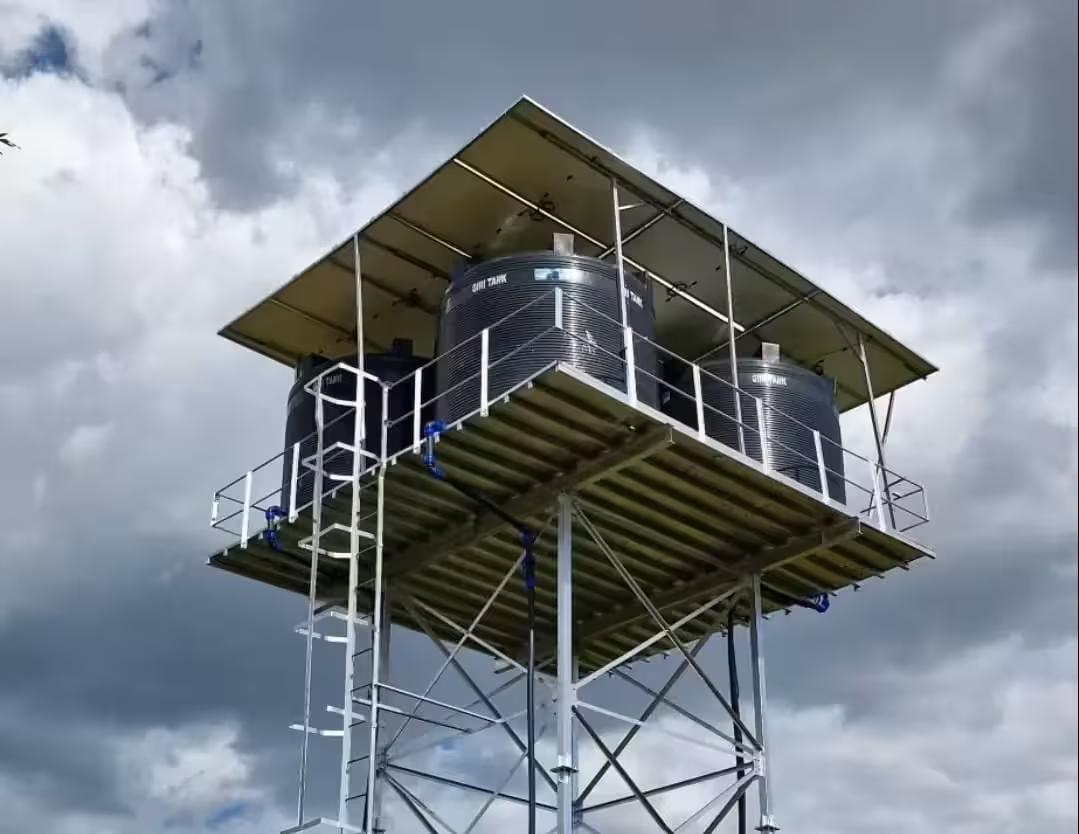
Structural Design and Engineering Specifications for Steel Tank Towers
What are steel tank towers?
Steel tank towersare elevated steel tank structures that carry a water tank above ground. By elevating the storage tank, these systems leverage gravity to deliver consistent, reliable water pressure for homes, agricultural, institutional, commercial, and industrial facilities without relying exclusively on continuous electric booster pumps. Reduced pump usage means heavy energy savings. Steel tank towers are also designed to improve water distribution or store water for future use. Generally, the work of an elevated tank stand is to provide combination of tank, support tower and foundation system that has to resist vertical loads, prevent corrosion, wind and sometimes seismic activities.
Whether you are managing municipal water distribution, a large-scale agricultural irrigation project, or a commercial real estate development, understanding the structural configurations, engineering parameters, and material choices is essential for a successful installation.
Looking for durable elevated water storage solutions? Discover how Afritec Steel Fabricators combines expert cutting, welding, and on-site installation to deliver high-capacity elevated steel tank towers engineered for commercial, agricultural, and industrial projects in Kenya
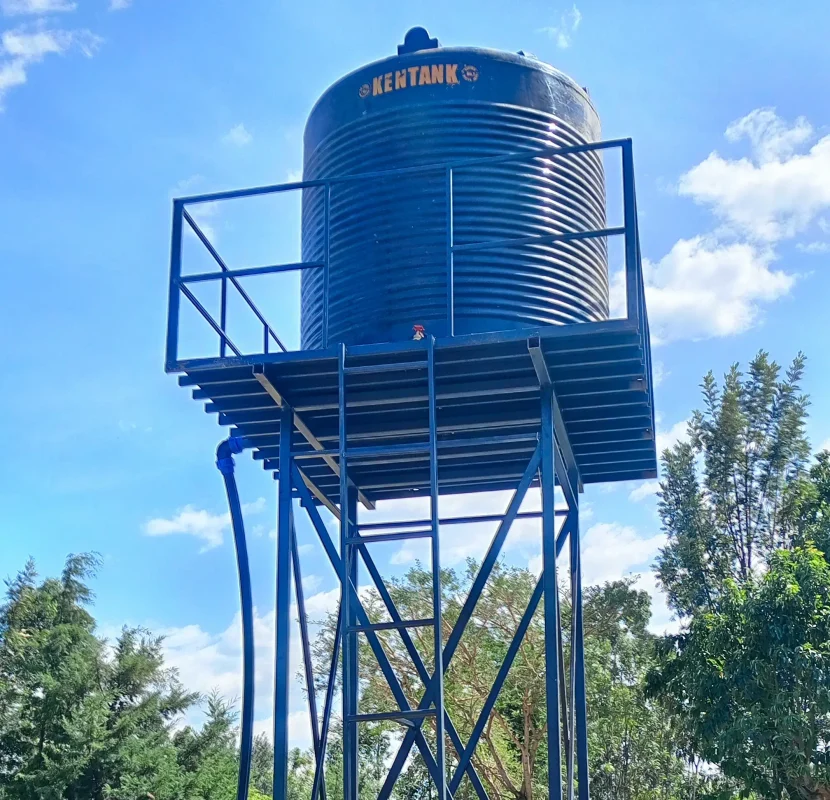
How Steel Water Tank Towers Work
The core principle behind a steel water tower is hydrostatic head pressure. Water is pumped from a borehole, municipal line, or harvesting system into the elevated storage tank. Because the tank sits high above the point of use, gravity pulls the water downward, creating natural pressure through the distribution piping network. The pumped water has the capability of travelling for longer distances as long as the right calculations are made.
Key Benefits of Steel Tank Towers
- Gravity Pressure Flow: Elevated steel tank stands create natural, steady water pressure through gravity without needing continuous electric pump operation. This is has an effect in cutting energy costs.
- Backup Storage: Steel tank stands in Kenya ensures a safe, continuous water reserve during power blackouts or municipal supply cuts.
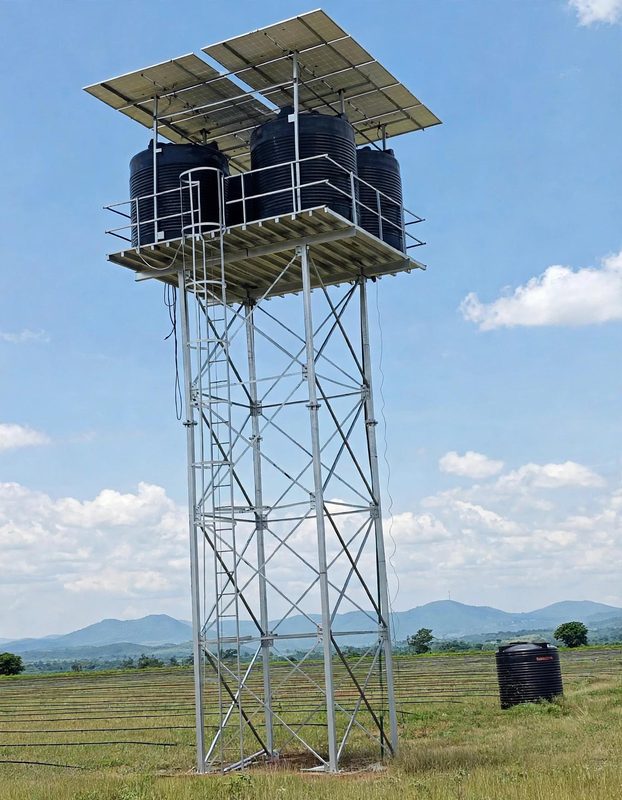
- Irrigation: Growers use steel tank towers to supply consistent head pressure for farm drip irrigation systems and sprinkler systems
- Space Saving: Lifts large volumes of water into the air, keeping ground areas free for parking, gardens, or buildings.
- Multi use: You can use elevated tank towers for solar mounting and security lights, thus eliminating the need for constructing multiple structures.

Key Structural Components of a Steel Tank Tower
Steel tower from Afritec Steel Fabricators are fabricated with precision to handle combined dead loads (water weight and tank structure) and lateral loads (high wind speeds and seismic forces). Our major structural components include:
- Tower Columns & Vertical Supports: Heavy-duty structural steel profiles, mainly structural steel beams (such as I-beams, H-beams), or hollow structural sections (HHS)—designed for maximum vertical load-bearing capacity.
- Cross-Bracing System: Diagonal tension rods or angle iron braces welded or bolted between steel columns to absorb wind shear and prevent structural buckling.
- Tank Support Platform: A grid of primary and secondary steel beams engineered to evenly distribute the heavy, dynamic weight of a full water tank across the top of the tower.
- Base Plates & Foundation Anchors: Thick steel base plates welded to the column feet, secured into reinforced concrete footings using high-strength anchor bolts.
- Access and Safety Features: OSHA/OSHS-compliant vertical safety-caged ladders, external maintenance platforms, and perimeter handrails.
Standard Tower Heights & Applications
Tower height directly dictates system head pressure and hydraulic performance. Here is a guideline when selecting a height for your structure.
- 6-Metre Towers: Ideal for residential homes, small farms, and localized commercial setups requiring modest pressure bumps.
- 9-Metre Towers: Frequently deployed for multi-story residential apartments, schools, and medium-scale agricultural drip irrigation networks.
- 12 to 15-Metre Towers (and Above): Engineered for industrial manufacturing plants, large commercial complexes, and community-wide public water supply projects.
Generally, the correct height for a steel tank stand depends on your building structure, the water pressure needed and where the water is to be supplied. For instance, community water towers are supposed to be raised very high to allow for water to be distributed to all corners of the village or town.
Compatible Water Tank Options
Steel towers are commonly paired with high-capacity storage tanks, including:
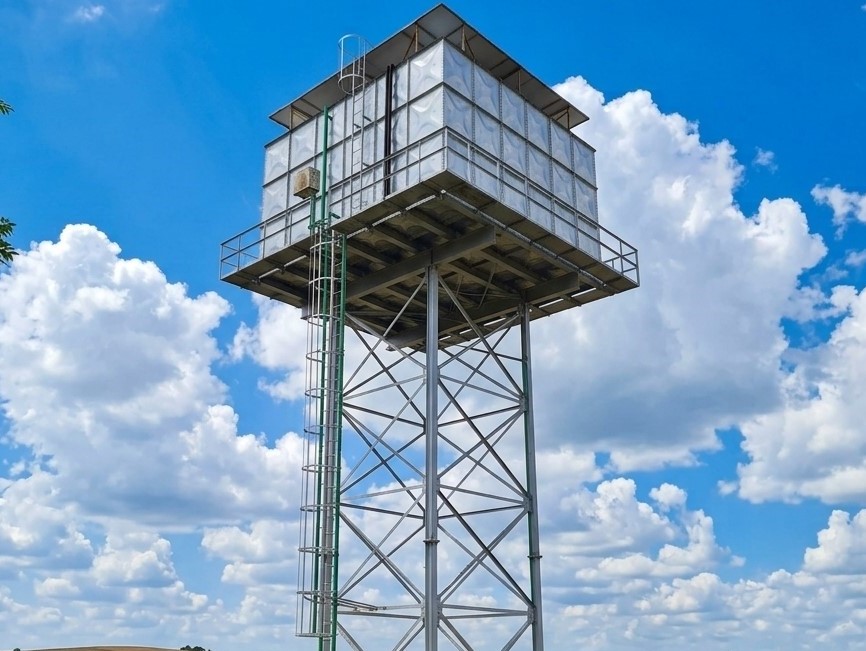
- Pressed Sectional Steel Tanks: Hot-pressed modular galvanized steel panels bolted together on-site. They offer flexible sizing, easy transport to remote locations, and straightforward integration onto tower platforms.
- Cylindrical Welded Steel Tanks: Factory-rolled vertical tanks providing seamless integrity for bulk liquid storage.
Critical Engineering Considerations
- Wind Load Engineering: Elevated tanks act as large structural sails. Wind tunnel data and local meteorological wind speeds must be modeled during structural design to prevent overturning moments.
- Corrosion Protection: Because structural steel faces continuous exposure to weather elements and moisture condensation, hot-dip galvanizing (HDG) to international standards or industrial-grade epoxy barrier coatings are mandatory for longevity.
- Geotechnical Soil Analysis: Soil bearing capacity tests must precede foundation construction to ensure the pad and anchor system can safely handle the cumulative dead load without differential settlement.
Corrosion Protection and Maintenance
Because steel towers are exposed to outdoor weathering and moisture, surface preparation and corrosion prevention are critical to extending asset lifespan:
- Hot-Dip Galvanizing: Immersing fabricated steel components in molten zinc creates a metallurgical bond that protects against rust, even in harsh tropical or humid environments.
- Industrial Primer & Bituminous Coatings: Applying high-performance epoxy primers and specialized topcoats adds an extra layer of defense against environmental pollutants and UV degradation.
- Periodic Inspections: Regular checks of anchor bolts, structural welds, and bracing joints ensure structural integrity is maintained year after year.
Steel Tank Towers Prices in Kenya.
The price of steel stands in Kenya generally from Kes. 70,000 for simple storage to as high as Kes. 500,000 or more for heavy load structures.
Are you planning to purchase elevated steel tank tower, Afritec Steel Fabricators is your reliable fabricator in Kenya. We also do design and fabrication of steel tanks, steel towers, warehouses and other structural steel works.
Frequently asked questions (FAQs)
What is the typical cost of a steel tank tower in Kenya?
Prices vary depending on the total tank capacity (e.g., 5,000L, 10,000L, 50,000L) and the required elevation height (ranging from 6 meters to over 15 meters). Material thickness, corrosion finish, and transport logistics also influence overall project costs.
Why choose steel over concrete water towers?
Steel towers offer faster fabrication and installation times, cleaner modular assembly, lower foundation weight footprints, and the flexibility to dismantle or relocate the structure if site requirements change
How do I maintain an elevated steel tower?
Routine maintenance involves inspecting anchor bolts for tightness, checking cross-bracing tension, clearing gutter/drainage systems, and re-applying protective anti-corrosion coatings every few years depending on environmental harshness.
How does a steel tank tower generate water pressure?
A steel tank tower elevates the water storage reservoir to a specific height, utilizing gravity to create natural hydrostatic head pressure. For every 1 meter of elevation, water pressure increases, allowing a consistent flow for taps, irrigation networks, or fire suppression systems without continuously running electric booster pumps
What are the main benefits of choosing a steel tower over a ground-level tank?
Steel tank towers provide a dependable, self-sustaining water distribution method across residential estates, commercial buildings, and agricultural farms where municipal water pressure fluctuates or electricity supply is inconsistent. Elevating the tank uses gravity to create natural hydrostatic head pressure, ensuring steady flow for taps, drip irrigation networks, and fire suppression systems without continuously running electric booster pumps
What tank capacities and tower heights are most common for Kenyan projects?
Capacities: Standard modular or pressed steel tanks typically range from 5,000 litres for small agricultural setups up to hundreds of thousands or even millions of litres for large industrial, institutional, or municipal projects.
What structural and geotechnical requirements are necessary before installation?
Because a full water storage tank places massive dead loads on the structure (where every 1,000 litres weighs approximately one metric ton plus the weight of the steel tower itself), proper engineering is crucial.
- Geotechnical Survey: Conducted prior to construction to assess soil composition, bearing capacity, and settlement risks.
- Reinforced Concrete Foundations: Heavy-duty concrete footings and structural anchor bolts are cast to securely tether the vertical H-beams or I-beams against severe weather and high winds.
What safety and plumbing accessories should be included on an elevated tower?
Fully compliant elevated tower installations feature critical accessories for safe operation and maintenance:
- Access Ladders & Safety Cages: Secure, fixed vertical ladders equipped with safety hoops or harness anchor points for maintenance crew protection
- Perimeter Catwalks & Handrails: Guarded service platforms around the top of the tower or tank base to enable safe inspection of manholes and valves
- Hydraulic Control Fixtures: Overflow pipes, washout drain valves at the base, float valves to prevent overfilling, and bypass configurations to maintain water flow during servicing
How tall should a steel water tower be?
Tower height depends entirely on your specific hydraulic and pressure requirements. While standard heights range anywhere from 3 meters to 12 meters or higher, taller towers require stricter wind-load engineering and more robust foundations. The height should be calculated based on required end-user pressure rather than choosing a standard size at random
What kind of foundation is required for an elevated steel water tank?
Due to the massive dead load of stored water (where every 1,000 liters weighs approximately one metric ton plus the structure itself), steel tank towers require heavily reinforced concrete foundations and engineered anchor bolts. Soil bearing capacity tests are typically conducted prior to installation to ensure safe load distribution
How do you protect a steel water tower from rust and corrosion?
Because steel towers are exposed to weathering, longevity relies on proper surface preparation and protective coatings. Hot-dip galvanizing (which forms a metallurgical bond with the steel) is the gold standard for rust prevention. Additional industrial epoxy primers and specialized topcoats are often applied for extreme environments.


CAN I GET A QOUTE FOR A TOWER FOR TWO (2) 10000L KENTANK. RAISED 9 METRES.
LOCATION: KATHAMA, MWALA – MACHAKOS
Dear Stephen,
Thank you for contacting us. The quotation has been sent to your email.
Regards,
Customer Service.